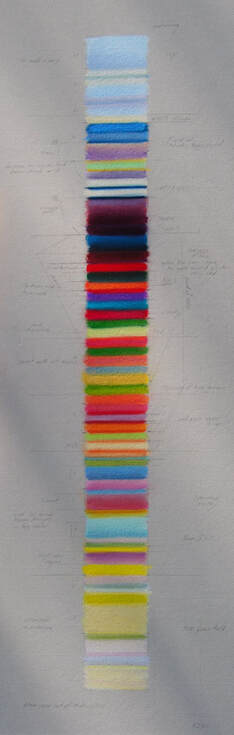
The Harp of Aengus 12X36 Pastel and pencil on paper
|
The Harp of Aengus
The Harp of Aengus is based on the harmonic pattern of Scarlatti's sonata K281.
The title of the work is reference to W.B. Yeats' poem, The Harp of Aengus.
Edain came out of Midhir's hill, and lay In some Irish folklore, Aengus is a god blessed with eternal youth. He is responsible for providing shelter to Etain, woman who has been taken from her husband to live with the Fairy King Midhir. She is tormented by Midhir'wife, who casts a series of spells on her, one of which turns her into a butterfly that is blown out to sea. As a butterfly, Etain hovers around a rock in the ocean for years until she is finally blown back to the shore. On land again, she sees Aengus, and comes to rest on his beautiful colored coat. Although no one else knows that the butterfly is Etain, Aengus does. He is in conflict with Midhir and cannot give her back to him, so he constructs a cage for her as a shelter. Etain flies in and out, carried by Aengus for many years.
The painting starts at the base of a hill and moves vertically up the landscape to the horizon and on to the sky, telling the story of Etain and Aengus in text. |